The Promise We Thought We’d Never See
When I first heard about Khanmigo back in 2023, I was skeptical in that deeply tired way that comes from watching education technology overpromise and underdeliver for twenty years. Another AI tutor? Another thing that would supposedly replace teachers? Another tool that would be abandoned by spring break? But here’s what actually happened: over 50 million tutoring sessions have now logged in since launch, and those aren’t bots running through test scenarios. Those are real students, in real moments of confusion, getting help at 10 PM on a Tuesday when their human teacher is asleep.
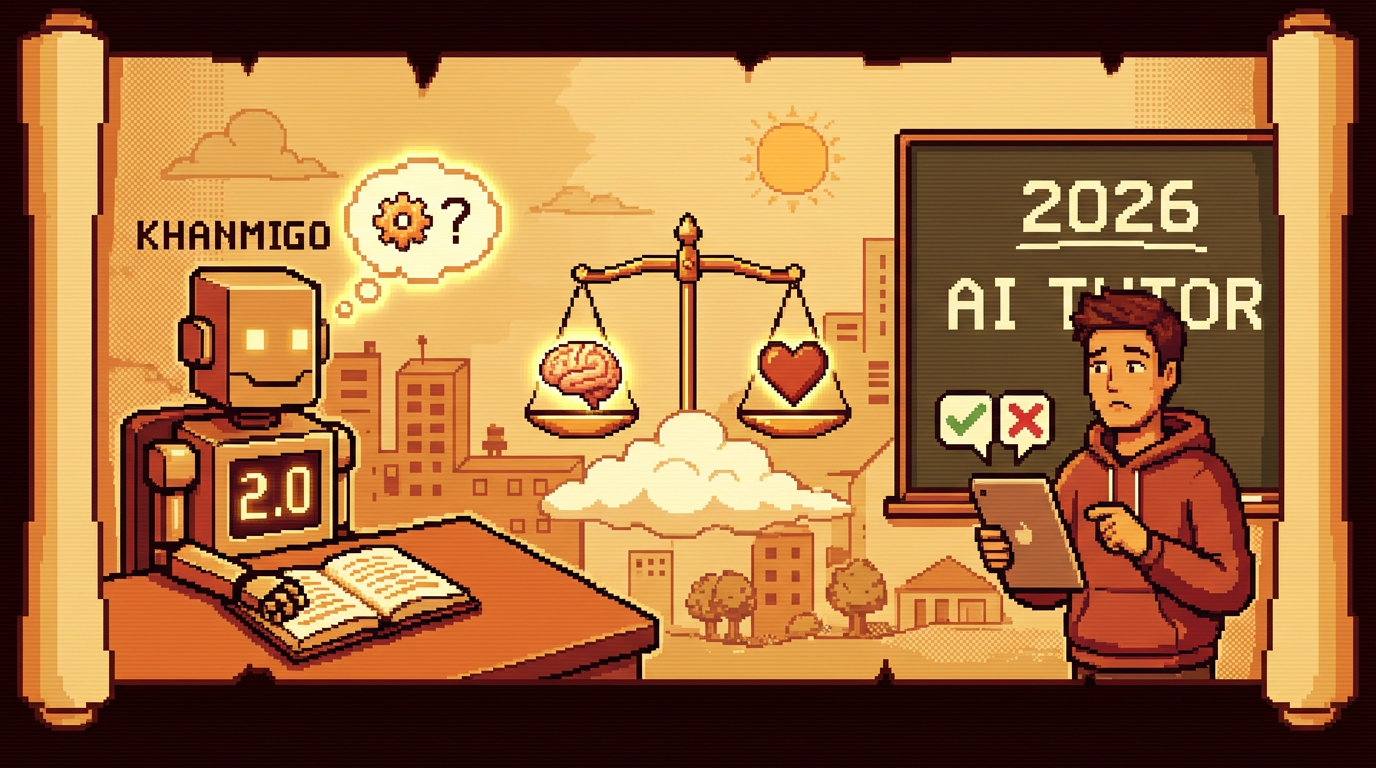
The numbers matter, but they’re not why I’m genuinely interested in Khanmigo 2.0. What caught my attention: middle school students using the platform showed a 23 percent improvement in math completion rates. That’s not a marginal gain. That’s the difference between a student who gives up three problems into a problem set and one who powers through to the end. In my classroom, that difference is the gap between a student who builds confidence and one who reinforces the belief that they can’t do math. Both trajectories compound. One leads somewhere; the other leads to learned helplessness.

Where It Excels: The Architecture of Better Questions
Let me walk you through what makes Khanmigo actually work, because it’s not what the marketing materials emphasize. It’s not that the AI is smart. It’s that it asks better questions than most tutors, including some humans.
A major research study from Stanford’s Graduate School of Education in 2025 compared different tutoring approaches and found something compelling: AI tutors that use Socratic questioning, where they guide students toward their own answers rather than handing over solutions, outperformed direct-answer tutors by 31 percent on retention tests two weeks later. Think about that timeframe. Two weeks. Not immediately, where novelty helps. Two weeks later, when the student is applying the concept to something new. The difference between teaching and learning often comes down to that gap.
Here’s a concrete example. A student is stuck on a problem about simplifying rational expressions. A bad AI tutor says: “Divide the numerator and denominator by their common factor.” The student writes it down, gets the right answer, feels successful for forty seconds, and forgets the logic by next week. A Socratic tutor says something like: “Look at these two expressions. What do you notice they have in common?” The student actually has to think. They have to notice a pattern. They have to build understanding instead of collecting answers.
Khanmigo 2.0 does this. It genuinely does. And that’s not a small thing.
The Real Breakthrough: English Language Learners
If you want to know where an educational tool actually matters, look at where the biggest gains are, not where the biggest numbers are. The data point that made me sit up straight: English language learners showed a 41 percent improvement in reading comprehension scores after eight weeks of Khanmigo use. Forty-one percent. In eight weeks.
I know what that means in practice because I’ve taught ELL students. I’ve watched a tenth grader parse a complex text at a pace that feels glacial to their English-fluent peers, not because they’re slow, but because they’re holding more cognitive load. They’re translating. They’re looking up words. They’re managing the anxiety of being behind. An AI tutor that works at their pace, that never shows impatience, that can explain a concept multiple ways without the human exhaustion factor, that changes something real. It removes the shame dimension that so often gets in the way of learning.
The Gates Foundation clearly thought this mattered too. In Q3 2025, they committed $15 million to expand Khanmigo access to Title I schools across twelve states. That’s not venture capital hype money. That’s foundation money, and foundations don’t give it away for marginal improvements. They saw something in those ELL gains that suggested this tool might actually help close opportunity gaps.
The Problem Nobody’s Talking About Enough
Here’s where I have to tell you the harder truth, the part that keeps me up at night as an educator: something troubling is happening on the other side of this equation. A January 2026 survey from the RAND Corporation found that 67 percent of teachers using AI tutoring tools reported their students became less likely to struggle productively with hard problems. Let me unpack that, because it’s devastating in a way that the positive metrics don’t capture.
Struggle is not the enemy of learning. Struggle is learning. When a student sits with a problem that doesn’t come easily, when they try an approach and it fails, when they have to think and think again until something clicks, that’s when real neural construction happens. That’s when they build agency and resilience alongside content knowledge. An AI tutor that’s always available, always ready with the next hint, that never lets a student sit in productive uncertainty for more than thirty seconds, it’s kind and efficient and it might be robbing students of something essential.
I think about the difference between a student who learns calculus because an AI guided them through every step, and a student who learns calculus because they had to sit with a difficult limit problem for twenty minutes, tried three strategies, and finally saw why one worked. Both students can solve the problem. Only one of them trusts themselves to solve problems they’ve never seen before.
What Matters Now: How We Choose to Use This
So where does this leave us? Khanmigo 2.0 is a genuinely useful tool with real constraints, and those two things are both true simultaneously. It’s excellent at removing barriers to access. It asks better questions than many humans would. It’s transformed the experience of ELL students in ways worth celebrating. It also requires careful stewardship, because tools that remove struggle can remove growth too, if we’re not paying attention.
The most useful integration I’ve seen works like this: use AI tutors for problem sets, practice, and immediate feedback loops. Use them for the 10 PM desperation sessions. Use them to help students do more work than a single teacher could ever grade. But preserve space for human struggle, for the problem that takes fifteen minutes, for the conversation where a teacher says “I don’t know, what do you think?” and sits in the silence. Let the AI handle scale. Let humans handle depth.
You can find detailed research on Khanmigo’s actual efficacy at Khan Academy Khanmigo Research and Efficacy, and broader context on AI in education through Stanford PACE Center AI in Education Reports. I’d love to know what you’re seeing in your classrooms or your child’s learning. Where do you think the line should be between AI support and human connection?