The Structural Breakdown of Traditional Higher Education
The American higher education system is in crisis, and it goes way beyond simple affordability concerns. With the average student loan burden now approaching $37,000 per borrower, we’re watching a financing model collapse that has operated on the assumption of unlimited demand and guaranteed returns. This debt load represents more than a financial burden. It’s a systemic failure in how we design pathways to economic mobility and professional development.
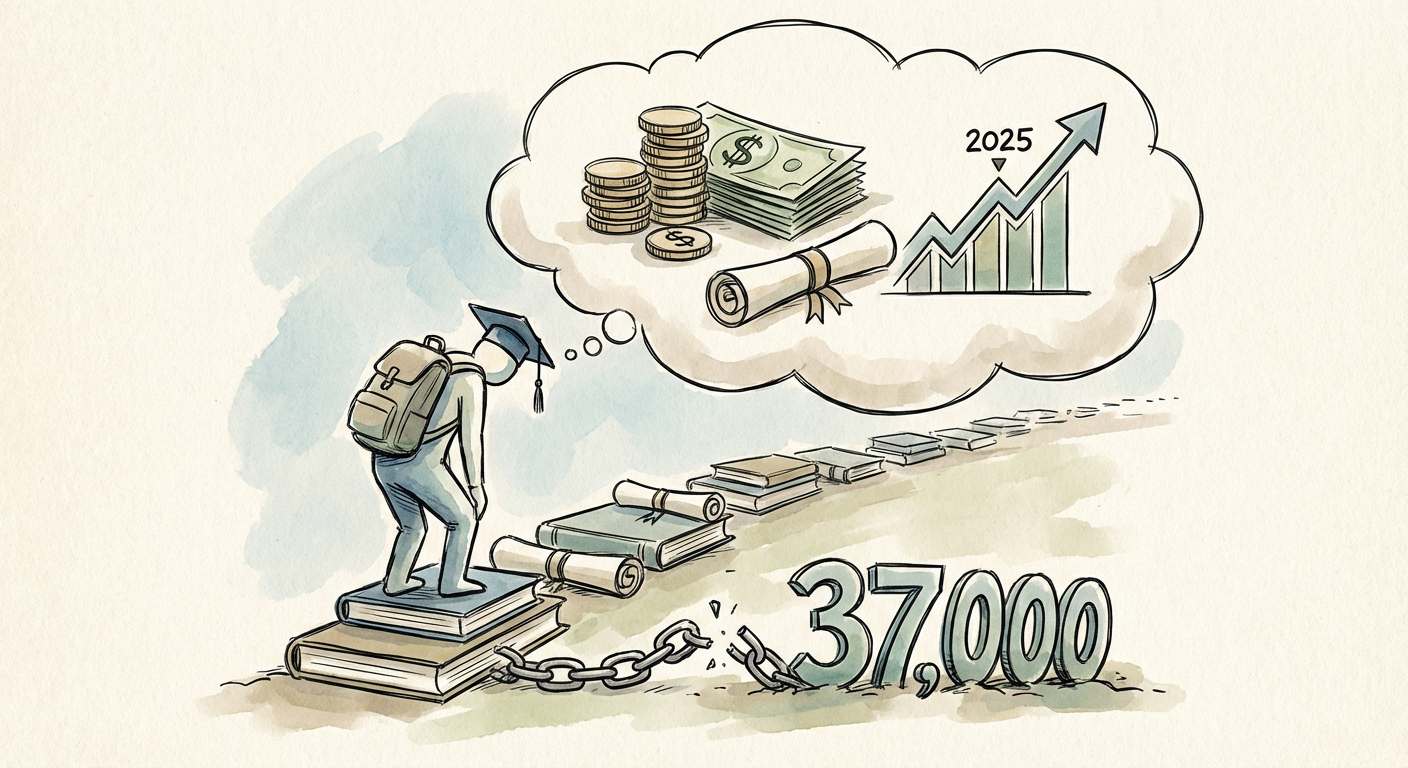
The evidence of this breakdown appears in enrollment patterns that would have been unthinkable a decade ago. For four straight years, college enrollment has declined as prospective students and families question whether the return on investment justifies the cost. This trend isn’t just about economic calculation. It’s a growing recognition that the traditional four-year degree pathway may be fundamentally misaligned with both individual needs and labor market realities. The system that once opened doors to middle-class prosperity now functions more like a barrier, requiring significant upfront investment with increasingly uncertain outcomes.
Alternative Pathways Getting Real Recognition
While traditional higher education grapples with declining enrollment, vocational and technical education programs are seeing unprecedented growth. Trade programs have reached record enrollment levels, driven partly by acute skilled labor shortages but more because people recognize these pathways offer more direct connections between education and employment. The systematic advantage of trade education lies not in its simplicity but in its clarity of purpose and outcomes. Students enter with specific career goals and graduate with immediately applicable skills.
The coding bootcamp sector provides another telling example of alternative pathway development. After rapid expansion between 2020 and 2022, the market is now consolidating, with successful programs showing clear employment outcomes while others struggle to justify their existence. This consolidation phase reveals the importance of quality control and outcome accountability that traditional higher education has often avoided. Successful bootcamps operate on principles of intensive, focused learning with direct industry connections, suggesting design elements that could be applied more broadly.
Community colleges represent perhaps the most significant growth area in higher education, not because they offer a cheaper version of traditional education but because they provide real flexibility. Students can pursue credentials that directly address local employment needs, transfer to four-year institutions when appropriate, or combine multiple pathways over time. According to College Board research, community colleges serve increasingly diverse student populations with varying educational and career objectives, requiring more sophisticated support systems than traditional institutions typically provide.
Financial Innovation and Structural Reform
Income Share Agreements represent one of several emerging financial models that attempt to align educational costs with actual outcomes rather than projected ones. Under these arrangements, students pay a percentage of their future income for a specified period rather than fixed loan amounts. While still in experimental phases, ISAs force institutions to consider the employment outcomes of their graduates more seriously, creating incentives for program quality and job placement support.
However, financial innovation alone cannot address the deeper structural issues within higher education. The current crisis comes from a fundamental misalignment between educational delivery methods, student needs, and economic realities. Traditional semester-based, campus-centered education assumes students can dedicate four years primarily to study, an assumption that excludes increasing numbers of potential learners who must balance education with work and family responsibilities. Real reform requires redesigning not just how we finance education but how we sequence and deliver it.
Toward a Competency-Based System
A truly responsive higher education system would organize around demonstrated competencies rather than seat time or credit hours. This approach requires thinking about learning progression differently, with clear benchmarks that allow students to advance as they master material rather than according to predetermined schedules. Such a system would necessarily incorporate multiple learning modalities, from intensive residential experiences to distributed online learning to workplace-based education.
The design challenge lies in creating pathways that maintain academic rigor while offering the flexibility that modern learners require. This means developing assessment methods that can reliably measure complex thinking and problem-solving abilities across different learning contexts. It also means creating institutional structures that can support learners who enter and exit programs according to their life circumstances rather than traditional academic calendars.
Industry partnerships become essential components of this redesigned system, not as afterthoughts but as integral elements of curriculum design and outcome assessment. Inside Higher Ed news frequently reports on successful collaboration models, but these examples remain isolated rather than systematic. Scaling such partnerships requires institutional incentive structures that reward long-term relationship building and outcome accountability over traditional metrics like enrollment numbers or research funding.
Implementation Sequence and Individual Variation
Change can’t happen simultaneously across all institutions and regions. Instead, successful transformation requires careful sequencing that builds on existing strengths while gradually introducing new elements. Community colleges, with their existing flexibility and local focus, may be natural laboratories for competency-based approaches. Four-year institutions might initially focus on redesigning specific programs or creating alternative tracks within traditional degree structures.
Individual learner variation demands multiple entry points and progression pathways within any reformed system. Some students will thrive in intensive, focused programs that prepare them for immediate employment. Others will benefit from broader, more exploratory approaches that develop critical thinking and adaptability over time. The key principle is ensuring that all pathways maintain quality and lead to meaningful economic opportunities while acknowledging that different individuals require different approaches to learning and skill development.
The higher education affordability crisis reflects a need for fundamental system redesign rather than incremental reform. Success will require coordinated efforts among educational institutions, employers, policymakers, and students themselves to create pathways that serve both individual aspirations and economic needs. The question isn’t whether change will occur, but whether we can design and implement changes systematically enough to serve current and future learners effectively.